Use case
Use this page when C2C12 is already the model and the missing piece is which library to screen, and how. Libraries are the sets named in the papers; no vendor catalog number is assigned. A diameter plate uses the Prestwick and LOPAC1280 class; a signature query uses the Connectivity Map. The plate is still dexamethasone on differentiated myotubes. The library pass is prevention only, one concentration, one well, diameter and viability. Five well types, Atrogin-1, and treatment timing wait for hit confirmation.
In one line
Confirm Day 4–7 myotubes → diameter plate uses the Prestwick + LOPAC1280 class, signature uses the Connectivity Map → library pass at 10 μM, one well, prevention, diameter and viability only → hits then get five well types, Atrogin-1, treatment timing, and one orthogonal arm → mice only after both arms agree.
Protocol overview
- 01Confirm Day 4–7 myotubes
- 02Diameter plate: Prestwick + LOPAC1280 class
- 03Signature: Connectivity Map
- 04Target sets start as binding or reporter assays
- 05Library pass: 10 μM, one well, prevention, diameter and viability
- 06Hits: five well types, Atrogin-1, treatment timing
- 07Mice only after both arms agree
Diagrams
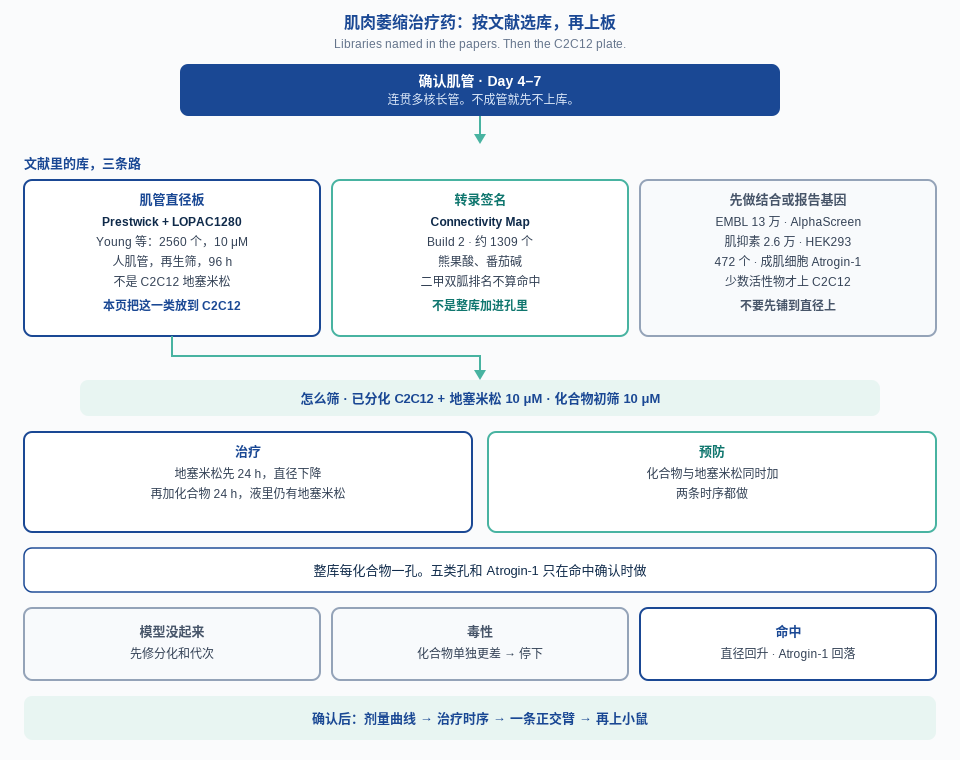
Library choice and the plate
The left box is the class used for a myotube-diameter plate, the middle box is the signature library, and the right box is the large sets that start as binding or reporter assays. The 2,560-compound run in Young et al. was one well per compound and imaging only. Do not run Atrogin-1 on every library well.
- 01[What this page answers] The lab already models with C2C12 and now wants compounds that treat muscle atrophy, without a library or a plate design. Libraries are the sets named in the papers. No vendor catalog number is assigned. The plate is still dexamethasone on differentiated myotubes. The library pass and hit confirmation are not the same plate. Medium changes, photography, and troubleshooting stay in the dexamethasone myotube protocol.
- 02[Confirm the myotubes first] Use only day 4–7 cultures that already have contiguous multinucleated tubes, with MYH4 higher than the undifferentiated control. Dexamethasone on myoblasts thickens later myotubes and lowers Atrogin-1, the opposite of atrophy[2]. Do not load a library onto a monolayer.
- 03[Diameter plate] The commercial libraries that a paper both names and actually plates onto muscle cells are the Prestwick Chemical Library and LOPAC1280. In Young et al. the Prestwick set is 1,280 FDA-approved marketed drugs and LOPAC1280 is 1,280 compounds, mostly marketed drugs and failed candidates. Combined, 2,560 compounds at 10 μM for 96 h went onto human primary myotubes, read for fusion index and myotube area, with IGF-1 as the positive control[9]. That run is a regeneration screen, not C2C12, and not a dexamethasone rescue. This page puts the same class onto differentiated C2C12 myotubes with dexamethasone, at 10 μM. Do not screen a second, heavily overlapping approved-drug set. PI3K/Akt inhibitors are not the first plate: this biology needs Akt intact[3].
- 04[Signature library] When an mRNA signature is available, query Connectivity Map Build 2. Kunkel queried about 1,309 small molecules; two skeletal-muscle atrophy signatures nominated ursolic acid, then checked on C2C12 and in mice. Tomatidine is the next compound from the same query[6, 7]. Metformin ranked high and fasted muscle weight did not rise above the fasted control, so rank alone is not a hit[6]. This is not 1,309 compounds dosed into dexamethasone wells. Ursolic acid and tomatidine in 22-month mice were diet studies, not a second library[8].
- 05[Do not put the large sets on the diameter camera first] MuRF1: the EMBL Chemical Biology Core library, 130,000 compounds from four commercial suppliers, started as an AlphaScreen of MuRF1–titin binding at 40 μM. A few compounds then went onto C2C12, with a 2 h pretreatment and then dexamethasone at 10 μM for 24 h; at 10 μM, compound #704946 abolished the diameter drop[10]. Myostatin: a 26,000-molecule set from the Institute of Medicinal Biotechnology was screened in HEK293 on the promoter and a SMAD-binding element; IMB0901 then went onto C2C12 with C26 conditioned medium. The paper gives no trade name[11]. FOXO: the Kamei lab’s own set of 472 food-derived and natural compounds, not a commercial catalog. The chemical names are Table 1 of Mendeley Data 10.17632/tgn8xwdr8v.1. The ones taken to Atrogin-1 in C2C12 myoblasts are the FOXO inhibitors in that table: 1α,25-dihydroxyvitamin D3, retinoic acid, 13-cis-retinoic acid, 17-AAG, cantharidin, and magnolol. The abstract also names 9-cis-retinoic acid[12].
- 06[Library pass] Dose myotubes in differentiation medium, not high-serum growth medium. Dexamethasone is 10 μM for 24 h in fresh 2% horse-serum differentiation medium. Each compound is one well, 10 μM, added with dexamethasone (prevention). Read diameter and viability. Do not run Atrogin-1 across the library. Young et al. ran 2,560 compounds as one well at 10 μM, scoring images and nuclei, with IGF-1 on every plate and Z′ at least 0.3; 16 of 29 primary hits still moved on a dose curve[9]. Keep that plate format. Do not keep their hit line of 40% larger than vehicle: that was a regeneration screen. Here a primary hit moves diameter from the dexamethasone well back toward vehicle, with viability still acceptable; they kept nuclei between 78% and 120% of control[9]. Every plate has vehicle, dexamethasone, and dexamethasone plus IGF-1. If dexamethasone is not smaller than vehicle, discard the plate. A 10 mM stock at 10 μM is 0.1% DMSO.
- 07[Treatment timing is for hits] The library pass is prevention: compound and dexamethasone together. Treatment waits for a primary hit: dexamethasone for 24 h, then, after the diameter falls, add the compound for another 24 h in fresh differentiation medium that still contains dexamethasone. Most published protectors are prevention. If a compound works only when added together, and not when added later, say so.
- 08[Five wells are confirmation, not the library pass] Reorder a primary hit as fresh powder before confirmation, as Bowen et al. did[10]. Confirmation wells are vehicle, dexamethasone, dexamethasone plus compound, compound alone, and dexamethasone plus IGF-1 (or insulin). IGF-1/PI3K/Akt lowers atrophy-related ubiquitin ligases by inhibiting FOXO[3]. Without the compound-alone well, thinning cannot be separated into toxicity. This step uses at least three independent biological repeats and includes Atrogin-1.
- 09[The call] First the model: dexamethasone versus vehicle has a smaller diameter. In the review, 10 μM for 24 h left pooled diameter near 70% of control and viability near 77%[1]. A library hit only has to move diameter back toward vehicle without viability worse than dexamethasone. Confirmation is what also requires Atrogin-1 to fall, and the compound alone not to look worse. A peeled sheet is toxicity. If 24 h morphology is flat, raise dexamethasone to 100 μM or extend to 48 h and rerun the library. Do not stack the higher dose and the longer exposure on the first pass.
- 10[After a hit] Run a dose curve, then one orthogonal arm matched to the indication. Inflammation: mouse TNF-α, often 100 ng/mL for 72 h. IL-6 or a cachexia-like question: 10 or 100 ng/mL for 48 h[4]. Myostatin: 10 ng/mL for 48 h[5]. If the question has already narrowed to MuRF1 or myostatin itself, go back to the binding or reporter library above rather than plating a pathway catalog. Activity only on dexamethasone, and none on the orthogonal arm, is selective for that inducer.
- 11[The cell layer ends here] Once both arms agree, switch to the mouse that matches the cause and read muscle weight or fiber diameter. Human myotubes come after that mouse. RUO.
Reagents / compounds
| Name | Role | Conc. |
|---|---|---|
| Prestwick Chemical Library | The marketed-drug half of the Young et al. myotube phenotypic screen. 1,280 FDA-approved marketed drugs in that paper | 与 LOPAC1280 合成 2560 个;10 μM、96 h;人原代肌管[9] |
| LOPAC1280 | The pharmacologically active half of the same paper. Mostly marketed drugs and failed candidates | 1280 个;10 μM[9] |
| Connectivity Map Build 2 | The query set for atrophy mRNA signatures. Ursolic acid and tomatidine came from here | 约 1309 个小分子;不是 C2C12 孔板[6, 7] |
| EMBL Chemical Biology Core library | MuRF1–titin binding screen. Compounds from four commercial suppliers, AlphaScreen first | 13 万个,初筛 40 μM;C2C12 上 #704946 为 10 μM[10] |
| Institute of Medicinal Biotechnology set | MSTN promoter and SMAD reporter. The paper gives no trade name | 2.6 万个分子;IMB0901 再到 C2C12[11] |
| Kamei lab food and natural compounds (472) | FOXO1/3a reporter. Full names are Mendeley Data 10.17632/tgn8xwdr8v.1 | 确认在 C2C12 成肌细胞的 Atrogin-1,不是肌管直径[12] |
| Dexamethasone | Primary inducer, added to differentiation medium on formed myotubes | 默认 10 μM、24 h[1] |
| Recombinant human IGF-1 | Positive well. A blank plate cannot be interpreted without it | 与地塞米松同加;终浓度按批次滴定[3] |
Readouts
The library pass reads diameter and viability. Confirmation adds Atrogin-1: diameter back up, Atrogin-1 down, viability no worse than the inducer. Then a dose curve, treatment timing, and one orthogonal arm.
Literature & manuals
- [1]PubMedPMID 41821373J Cachexia Sarcopenia Muscle · 2026A Systematic Review and User Reference of Phenotypic and Molecular Characteristics of Dexamethasone-Mediated C2C12 Muscle Atrophy.
- [2]PubMedPMID 28539819Int J Med Sci · 2017Dexamethasone treatment at the myoblast stage enhanced C2C12 myocyte differentiation.
- [3]PubMedPMID 15125842Mol Cell · 2004The IGF-1/PI3K/Akt pathway prevents expression of muscle atrophy-induced ubiquitin ligases by inhibiting FOXO transcription factors.
- [4]PubMedPMID 22669242Am J Physiol Endocrinol Metab · 2012JAK/STAT3 pathway inhibition blocks skeletal muscle wasting downstream of IL-6 and in experimental cancer cachexia.
- [5]PubMedPMID 25132809J Int Soc Sports Nutr · 2014L-leucine, beta-hydroxy-beta-methylbutyric acid (HMB) and creatine monohydrate prevent myostatin-induced Akirin-1/Mighty mRNA down-regulation and myotube atrophy.
- [6]PubMedPMID 21641545Cell Metab · 2011mRNA expression signatures of human skeletal muscle atrophy identify a natural compound that increases muscle mass.
- [7]PubMedPMID 24719321J Biol Chem · 2014Systems-based discovery of tomatidine as a natural small molecule inhibitor of skeletal muscle atrophy.
- [8]PubMedPMID 26338703J Biol Chem · 2015Identification and Small Molecule Inhibition of an ATF4-dependent Pathway to Age-related Skeletal Muscle Weakness and Atrophy.
- [9]PubMedPMID 29498891SLAS Discov · 2018MyoScreen, a High-Throughput Phenotypic Screening Platform Enabling Muscle Drug Discovery.
- [10]PubMedPMID 28887874J Cachexia Sarcopenia Muscle · 2017Small-molecule inhibition of MuRF1 attenuates skeletal muscle atrophy and dysfunction in cardiac cachexia.
- [11]PubMedPMID 30922397Skeletal Muscle · 2019IMB0901 inhibits muscle atrophy induced by cancer cachexia through MSTN signaling pathway.
- [12]PubMedPMID 41790122Biosci Biotechnol Biochem · 2026Compounds identified by screening that inhibit the activity of transcription factor FOXO1/3a suppress dexamethasone-induced atrogin1 expression in C2C12 myoblasts.