TGF-β/Smad signaling pathway
TGF-β family ligands signal through type II/type I serine-threonine kinase receptors to activate receptor-regulated SMADs (e.g., SMAD2/3), which partner with SMAD4 for nuclear transcriptional control. The pathway is central to development, immune homeostasis, fibrosis, and context-dependent tumor suppression versus pro-metastatic programs.
1. Key targets
Core nodes
- TGFBR1 / ALK5 & TGFBR2
Type I/II receptor kinases; ligand-induced assembly and trans-phosphorylation initiate SMAD cascades.
- SMAD2 / SMAD3
R-SMADs; C-terminal SSXS phosphorylation, then complex formation with SMAD4.
- SMAD4
Co-SMAD; SMAD4 loss (e.g., pancreatic cancer) reframes downstream TGF-β biology.
Upstream & cofactors
- TGFB1/2/3; BMP / Activin / GDF parallel branches
- Co-receptors such as TGFBR3 and Endoglin (ENG)
- SMAD7 / SMURF1/2 feedback and receptor turnover
Downstream & non-canonical
- SNAIL/SLUG, ID family, cell-cycle and matrix programs
- TAK1–JNK/p38, PI3K, Rho-like GTPases (context-dependent)
Supplement: TGF-β/Smad–related targets (gene symbols)
Below the overview, HGNC symbols group TGF-β superfamily ligands (including latent complexes), BMP/GDF/activin/nodal arms, extracellular antagonists, type I–III receptors & membrane helpers, R-/co-/I-SMADs with ubiquitin/DUB regulators, nuclear cofactors, EMT/matrix readouts, non-canonical TAK1–MAPK nodes, and PI3K–mTOR crosstalk. SMAD9 is the principal BMP-branch R-SMAD (historically SMAD8/BMP-SMAD). Annotate splice isoforms and context-dependent coupling with databases/papers.
TGF-β ligands & latent complex
TGF-β ligands & latent TGF-β–binding proteins
TGFB1, TGFB2, TGFB3, TGFB1I1, LTBP1, LTBP2, LTBP3, LTBP4, FBN1, FBN2, FBN3, LRRC32, ITGB6, ITGB8, ITGAV
BMP / GDF / activin / nodal arms
BMP / GDF family ligands
BMP2, BMP3, BMP4, BMP5, BMP6, BMP7, BMP8A, BMP8B, BMP9, BMP10, BMP15, GDF1, GDF2, GDF3, GDF5, GDF6, GDF7, GDF8, GDF9, GDF10, GDF11, GDF15
Activin / inhibin / Nodal / Lefty / AMH
INHA, INHBA, INHBB, INHBC, INHBE, NODAL, LEFTY1, LEFTY2, AMH, FST, FSTL1, FSTL3, FSTL4, FSTL5
Extracellular modulation & processing
Extracellular antagonists & modulators
NOG, CHRD, CHRDL1, CHRDL2, GREM1, GREM2, DAND5, CER1, USAG1, SOST, BAMBI, CRIM1, CRIM2, ECM1, THBS1, THBS2, THBS3, THBS4
Proprotein convertases (ligand maturation)
FURIN, PCSK5, PCSK6, PCSK7, PACE4, TMPRSS6
Receptors & membrane helpers
Type II receptors & type III co-receptors
TGFBR2, ACVR2A, ACVR2B, BMPR2, AMHR2, TGFBR3, ENG, RGMA, RGMB, NEO1, HJV, SCUBE1, SCUBE2, SCUBE3, DCN, BGN, LUM
Type I receptor kinases (ALK family)
TGFBR1 is ALK5; BMPR1A/1B are often called ALK3/6; ACVRL1 is ALK1.
TGFBR1, ACVR1, ACVR1B, ACVR1C, BMPR1A, BMPR1B, ACVRL1
SMAD core & regulation
R-SMADs, co-SMAD & inhibitory SMADs
SMAD1, SMAD2, SMAD3, SMAD4, SMAD5, SMAD6, SMAD7, SMAD9
SMAD anchoring, ubiquitination & deubiquitin regulators
ZFYVE9, STRAP, SMURF1, SMURF2, TRIM33, NEDD4L, WWP1, UBE2D1, UBE2D3, USP9X, USP11, USP15, USP33, USP34, STUB1, RNF111, PPM1A, PPP2CA, PPP2CB
Nuclear cofactors & transcriptional adaptors (selected)
FOXH1, SKI, SKIL, TGIF1, TGIF2, TGIF2LX, TGIF2LY, MEN1, CTNNBIP1, RUNX1, RUNX2, RUNX3, EP300, CREBBP, MED1, MED15, MED24, MED31
EMT & matrix readouts
EMT transcription factors & matrix readout genes
SNAI1, SNAI2, TWIST1, TWIST2, ZEB1, ZEB2, ID1, ID2, ID3, ID4, CDH1, CDH2, VIM, COL1A1, COL1A2, COL3A1, ACTA2, TAGLN, FN1
TGF-β–induced CAF / stromal surface markers (selected)
LRRC15 is a TGF-β–SMAD–induced transmembrane LRR protein enriched on CAFs; can couple downstream to ITGB1/FAK→PI3K.
LRRC15, FAP
Non-canonical MAPK & mTOR crosstalk
Non-canonical: TAK1–TAB–TRAF & MAPK branches
MAP3K7, TAB1, TAB2, TAB3, TRAF4, TRAF6, TRAF2, MAPK8, MAPK9, MAPK10, MAPK14, MAPK11, MAPK12, MAPK13, MAPKAPK2, MAPKAPK3, RHOA, RHOC, CDC42, RAC1, ROCK1, ROCK2, PAK1, PAK2
Crosstalk with PI3K–Akt / mTOR (selected)
PIK3CA, PIK3CB, PIK3CD, AKT1, AKT2, AKT3, MTOR, RPTOR, RICTOR, TSC1, TSC2, RHEB
2. Suggested experimental readouts
For phospho-antibodies, pair with total protein, time-course stimulation, and controls; for IF, optimize fixation and clone selection.
- p-SMAD2 / p-SMAD3 (sites depend on clone datasheet, e.g., Ser465/467)
- Total SMAD2/3/4; nuclear/cytoplasmic distribution (fractionation or IF)
- E-cadherin / N-cadherin / Vimentin (EMT panel)
- Collagen I (COL1A1), α-SMA (ACTA2)—fibrosis / myofibroblast readouts
- CD31 + α-SMA—pericyte/stroma interactions (model-dependent)
- IFNγ signatures, FoxP3, CD8 (immune-suppressive TME pairing, project-dependent)
3. TGF-β vs BMP / Activin / Nodal branches
| Ligand (examples) | Type I receptor bias | R-SMAD | Notes |
|---|---|---|---|
| TGF-β / Activin / Nodal | ALK4 / ALK5 / ALK7 | SMAD2/3 (+ SMAD4) | Sensitive to SB431542 / A83-01; do not conflate with BMP. |
| BMP / GDF | ALK1/2/3/6 等(语境依赖) | SMAD1/5/8 (+ SMAD4) | Parallel branch; pick inhibitors per ligand context. |
4. Context dependence: cancer & TME
- Epithelial phase: TGF-β often enforces growth arrest / pro-apoptotic programs—pair p-SMAD with cyclins/CDKs.
- Progression / mesenchymal: EMT, matrix stiffening, immunosuppressive myeloid/Treg axes often couple to TGF-β.
- SMAD4−/−: In SMAD4-null contexts (e.g., PDAC), TGF-β can shift pro-invasive—annotate genotypes.
TGF-β/Smad–related antibodies (curated)
5. Product lines & on-site search
Primary & phospho antibodies
TGFB1, TGFBR1/2, SMAD2/3/4/7, p-SMAD2/3, SNAIL, α-SMA, Collagen I, Endoglin—WB/IHC/IF/FC as applicable.
Recombinant proteins / cytokines
Recombinant TGF-β1/2/3 for stimulation; BMP ligands for branch controls or competition (project-dependent).
Functional reagents & quantification
Neutralizing antibodies, soluble traps/Fc fusions (availability-dependent), species-matched TGF-β1 ELISAs—follow datasheets and ethics.
6. Inhibitors & tool compounds (summary)
For research use; follow lab SOP, compound datasheets, and ethics approvals.
ALK4/5/7; canonical TGF-β receptor blockade.
ALK5; clinical/clinical-stage TGF-β axis probe.
ALK4/5/7; common in PSC/organoid workflows.
ALK4/5/7; PSC/organoid TGF-β/Activin/Nodal suppression.
Oral selective ALK5 inhibitor; fibrosis/tumor controls.
Highly selective TGFBR1; immune–stroma studies.
SMAD3 transcriptional interface disruptor (tool).
Smad3 phospho inhibition; fibrosis readouts.
7. Pathway schematic
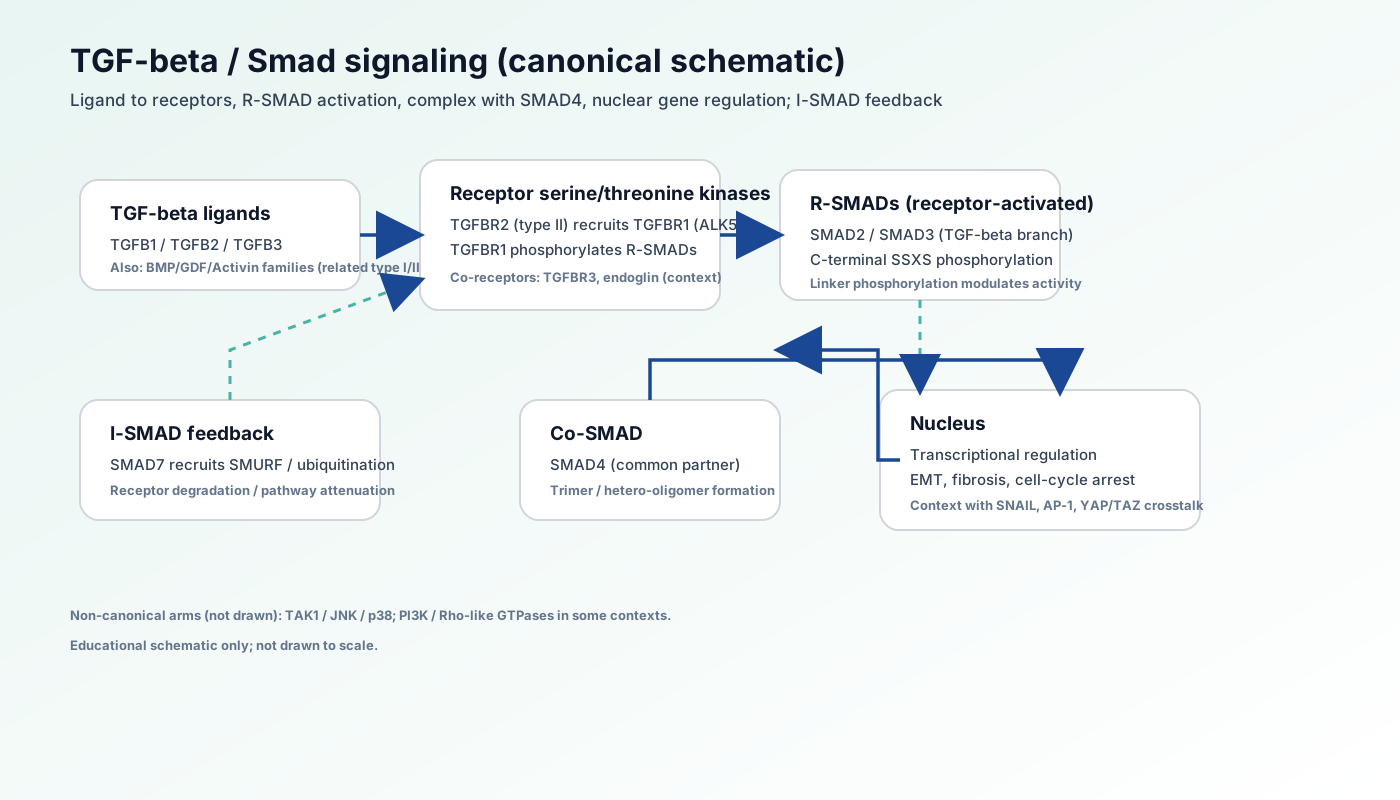
- Ligand–type II–type I (ALK5) assembly
- R-SMAD C-terminal phosphorylation
- Complex with SMAD4 and nuclear entry
- Transcriptional regulation & feedback (SMAD7, etc.)
8. Pathway biology overview
The TGF-β superfamily governs development, repair, and immune tolerance; in cancer it can enforce epithelial restraint yet promote late-stage invasion—interpret with genotype, stroma, and immune composition.
- Fibrosis: fibroblast activation & collagen deposition (liver/lung/kidney models)
- Immunity: crosstalk with Tregs, effector T cells, MDSC-like programs
9. Related pathways on this site
10. External databases & modification resources
- KEGG: hsa04350 TGF-beta signaling pathway
- Reactome: Signaling by TGF-beta Receptor Complex
- WikiPathways (search: TGF-beta)
- PhosphoSitePlus (SMAD/receptor modification sites)
11. References
Receptors & SMAD mechanisms
- • Shi Y, Massagué J. (2003). Cell. 113(6):685-96.
- • Massagué J, Sheppard D. (2017). Nat Rev Mol Cell Biol. 18(7):436-454.
Tumor microenvironment & targeting
- • Pickup M, Novitskiy S, Moses HL. (2013). Nat Rev Cancer. 13(11):788-99.
- • Herbertz S, et al. (2015). Drug Discov Today. 20(7):787-97.