Cell cycle signaling
The eukaryotic cell cycle is driven by CDK–cyclin pairs and guarded by the Rb–E2F switch, replication licensing, DNA-damage responses, and the spindle assembly checkpoint. Mitogens (RTK–Ras–ERK, PI3K/Akt, etc.) and stress cues set the G1 restriction point and the G2/M transition; cancer often shows cyclin/CDK amplification, CKI loss, or checkpoint bypass—making the cycle a central space for antibody readouts and CDK4/6-class therapeutics.
1. Key targets
CDK–cyclin engine
- G1 / G1–S
Cyclin D–CDK4/6 integrates mitogens; Cyclin E–CDK2 promotes licensing and S entry.
- S / G2
Cyclin A–CDK2 supports replication; Cyclin A/B–CDK1 drives mitosis (MPF).
- CKIs & regulatory subunits
INK4 (p16) inhibits CDK4/6; Cip/Kip (p21/p27) broadly inhibit pairs; E3s such as Skp2 tune cyclin turnover.
Rb – E2F
- Hypo-p-Rb restrains E2F-dependent S-phase genes
- CDK progressive p-Rb releases E2F1–3 for PCNA/MCM/TS programs
Mitosis & exit
- Aurora A/B, PLK1, CDC25s tune centrosomes and CDK1 activation
- APC/C–Cdc20/Cdh1 targets securin and Cyclin B for anaphase/exit
2. Suggested experimental readouts
p-Rb epitopes differ by clone; Ki-67 is a proliferation index—interpret kinetics; pair EdU/BrdU with cyclin IF when possible.
- p-Rb (Ser807/811, etc.) with total Rb; Cyclins D1, E, A, B1
- p21, p27, p16; phospho-CDK when clone-validated
- Ki-67, PCNA, MCM2/5, Geminin (S-phase dynamics)
- p-Histone H3 (Ser10)—mitosis; gamma-H2AX—stress/DDR
- p-CHK1 (Ser345), p-CHK2 (Thr68)—checkpoint activation
3. Major checkpoints & sensors (overview)
| Phase | Core question | Example nodes |
|---|---|---|
| G1 / restriction | Commit to replication and S-phase transcription? | Cyclin D–CDK4/6, Cyclin E–CDK2, Rb, E2F, p16/p21/p27 |
| Intra-S / stress | Fork integrity under stress? | ATR–CHK1, RPA, gamma-H2AX, PCNA |
| G2 / M | Replication complete with tolerable damage? | WEE1, CDC25, Cyclin B–CDK1, CHK1/2 |
| SAC | Chromosomes bioriented on the spindle? | Mad2, BubR1, Cdc20–APC/C |
4. Cancer, CDK4/6 inhibitors & resistance
- CDK4/6 + endocrine / targeted partners: HR+ breast cancer often pairs CDK4/6i with endocrine/targeted partners—annotate Rb status and Cyclin E1 bypass cues.
- p16 / CDKN2A loss: weakens CDK4/6i dependency; MAPK/CDK2 compensation appears in many models.
- Replication stress & DDR: ATR/CHK1 couples tightly to cycle biology—pair synchronization strategies in SL/CRT studies.
Cell cycle–related antibodies (curated)
5. Product lines & on-site search
Primary & phospho antibodies
Cyclins D1/E/A/B, p-Rb, CDK2/4/6, phospho-CDK, E2F1, p21/p27/p16, Ki-67, PCNA, PLK1, Aurora A/B, gamma-H2AX, p-CHK1/2—WB/IHC/IF/FC per datasheet.
Functional reagents & proliferation readouts
EdU/BrdU kits, PI/RNase cell-cycle flow panels—availability-dependent.
6. Inhibitors & tool compounds (summary)
Clinical agents are prescription drugs; for research, follow datasheets, ethics, and off-target panels.
CDK4/6; labels vary by region/indication.
Multi-CDK tool (CDK2/1/5/9 bias—check profiling).
Broad CDK / transcriptional effects—toxicity context.
CDK1 or PLK1 tools; mitotic synchronization.
WEE1 inhibitor; G2/M checkpoint studies.
ATR inhibitor; pair with RS/DDR readouts.
7. Pathway schematic
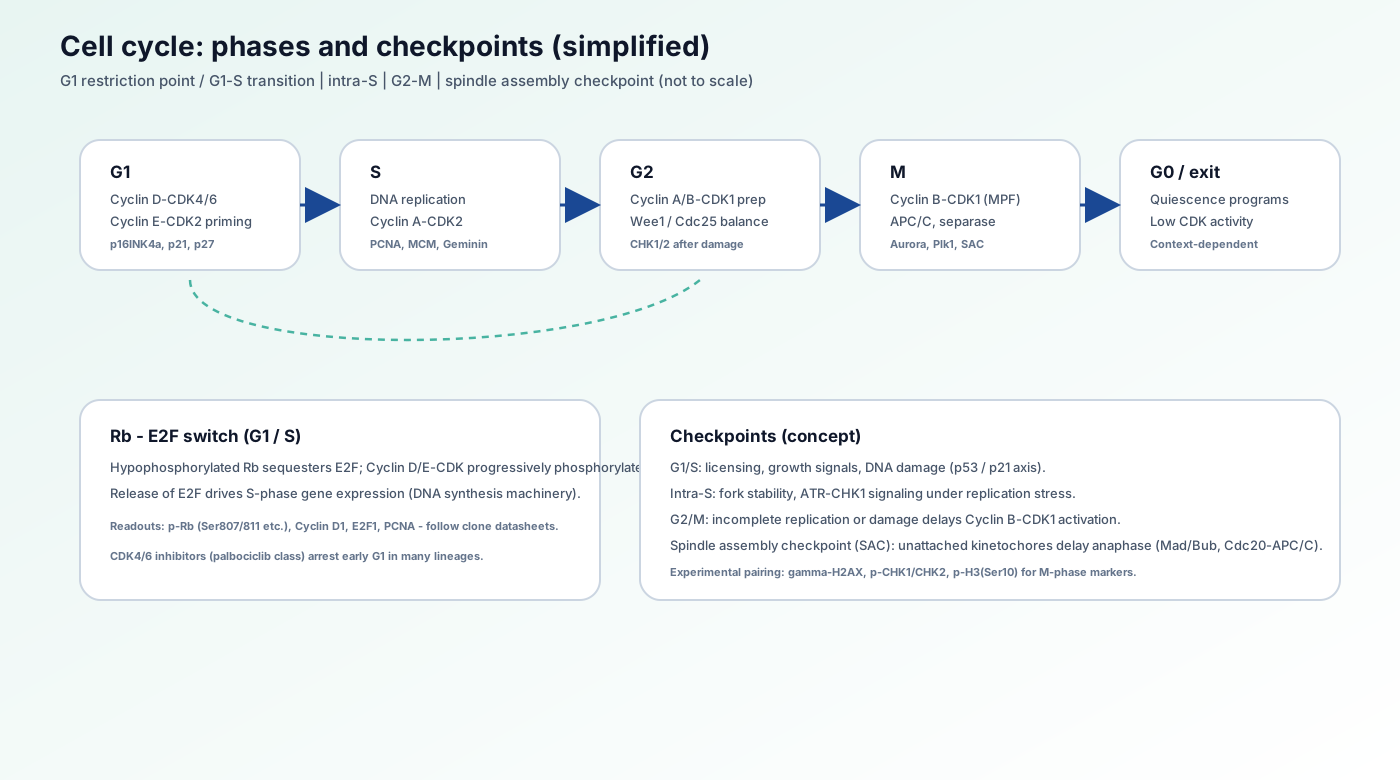
- G1: Cyclin D–CDK4/6 integrates growth cues
- S: forks with Cyclin A–CDK2
- G2/M: Wee1–Cdc25 and Cyclin B–CDK1
- Rb–E2F plus CKIs set the G1/S threshold
8. Pathway biology overview
The cycle is not a uniform clock but an ordered sequence of switches: Rb–E2F, APC/C, and licensing modules create nonlinear thresholds so cells can reversibly—or irreversibly—respond to nutrients, DNA lesions, and kinetochore attachment. Development and regeneration demand precise CDK phasing; senescence and cancer often reflect checkpoint fatigue or cyclin/CDK hyperactivation.
- Quiescence/exit: low CDK, CKI induction, p53 context
- Polyploidy/endoreduplication: CDK–APC imbalance readouts
9. Related pathways on this site
10. External databases & modification resources
- KEGG: hsa04110 Cell cycle
- Reactome: Cell Cycle
- WikiPathways (search: cell cycle)
- PhosphoSitePlus (CDK/Rb/checkpoint modifications)
11. References
Cycle engine & cancer
- • Malumbres M, Barbacid M. (2009). Cell cycle, CDKs and cancer: a changing paradigm. Nat Rev Cancer. 9(3):153-66.
- • Hanahan D, Weinberg RA. (2011). Hallmarks of cancer: the next generation. Cell. 144(5):646-74.
Checkpoint concepts
- • Hartwell LH, Weinert TA. (1989). Checkpoints: controls that ensure the order of cell cycle events. Science. 246(4930):629-34.
- • Elledge SJ. (1996). Cell cycle checkpoints: preventing an identity crisis. Science. 274(5293):1664-72.