Endocrine and hormone signaling
The endocrine system couples hormones (steroids, amino-acid derivatives, peptides/proteins) to target receptors, governing metabolism, growth, reproduction, stress, and electrolyte balance. Nuclear receptors drive genomic programs; membrane receptors (RTKs, GPCRs, etc.) initiate kinase cascades that intersect metabolism, immunity, and hormone-dependent cancer phenotypes.
1. Key targets
Nuclear receptors & sex-hormone axis
- ESR1 / ESR2
Estrogen receptors; proliferation/transcription programs in breast, uterus, etc.—core to endocrine therapy and resistance.
- AR
Androgen receptor; prostate and subset breast contexts—splice variants (AR-Vs) link to resistance.
- PGR / NR3C1
Progesterone and glucocorticoid receptors—reproductive cycling, stress responses, immune–metabolic coupling.
Metabolic & growth axes (membrane receptors)
- INSR、IGF1R、IRS1/2
- GH–IGF1 axis: GHR, JAK2/STAT5 downstream
- Extensive crosstalk with PI3K/Akt, mTOR, MAPK
Thyroid & hypothalamic–pituitary
- TSHR、THRA/THRB(甲状腺激素核受体)
- TRH, TSH, GnRH, FSH/LH, PRL—peptide hormones and cognate GPCR/glycoprotein receptors
Supplement: endocrine & hormone targets (gene symbols)
Below the overview above, HGNC symbols are grouped by nuclear receptors, steroidogenesis, thyroid–parathyroid, hypothalamic–pituitary, metabolic/adipokine, reproduction/lactation, catecholamines, membrane receptors, carriers/transporters, and melatonin/circadian modules, plus selected immunometabolic crosstalk. Mind splice isoforms and paralogs—annotate with HGNC/UniProt.
Nuclear receptors
Nuclear receptor superfamily (major members)
Ligands include steroids, thyroid/retinoid/vitamin D, bile acids, oxysterols; mind splice isoforms and tissue bias.
NR0B1, NR0B2, THRA, THRB, RARA, RARB, RARG, RXRA, RXRB, RXRG, PPARA, PPARD, PPARG, NR1D1, NR1D2, NR1H2, NR1H3, NR1H4, NR1I2, NR1I3, VDR, RORA, RORB, RORC, HNF4A, HNF4G, NR2C1, NR2C2, NR2E1, NR2E3, NR2F1, NR2F2, NR2F6, ESR1, ESR2, ESRRG, ESRRB, ESRRA, PGR, AR, NR3C1, NR3C2, NR4A1, NR4A2, NR4A3, NR5A1, NR5A2, NR6A1
Steroidogenesis & steroid metabolism
Steroidogenesis & steroid-metabolizing enzymes (gonadal/adrenal)
STAR, CYP11A1, CYP11B1, CYP11B2, CYP17A1, CYP19A1, CYP21A2, HSD3B1, HSD3B2, HSD11B1, HSD11B2, HSD17B1, HSD17B2, HSD17B3, HSD17B4, HSD17B6, HSD17B7, HSD17B8, HSD17B10, HSD17B11, HSD17B12, HSD17B13, HSD17B14, SRD5A1, SRD5A2, SRD5A3, AKR1C1, AKR1C2, AKR1C3, AKR1C4, SULT1A1, SULT1E1, SULT2A1, UGT2B7, UGT2B15, UGT2B17
Thyroid, parathyroid & calcium homeostasis
Hypothalamic–pituitary hormones
Metabolic hormones & adipokines
Reproductive axis & lactation
Adrenal medulla & catecholamines
Membrane receptors (glycoprotein hormones, GPCRs, etc.)
Binding proteins & transporters
2. Suggested experimental readouts
For nuclear receptors, consider subcellular localization, cofactors, and chromatin context; pair phospho readouts with stimulation/antagonism and total protein controls.
- Nuclear translocation of ERα/AR/PGR/NR3C1 and target genes (TFF1, KLK3, GRE reporters—model-dependent)
- INSR/IGF1R and IRS1 Tyr phosphorylation; Akt, S6K, 4E-BP1 (mTOR pairing)
- STAT5 (PRL/GH axis), STAT3 (context-dependent)
- Thyroid hormone response genes (e.g., DIO2, UCP) and THRA/THRB isoform expression
- Steroidogenic enzymes (CYP11A1, HSD3B, etc.) and adrenal/gonadal IHC
3. Nuclear receptors vs membrane hormone signaling
| Hormone class (examples) | Primary receptors | Initial signal | Notes |
|---|---|---|---|
| Steroids (estrogen/progestin/androgen/glucocorticoid) | ESR / PGR / AR / NR3C1… | Ligand–receptor nuclear transcriptional programs | Slower kinetics; cofactors and chromatin accessibility matter. |
| Peptide/protein (insulin, IGF, GH) | INSR、IGF1R、GHR… | RTK → IRS / JAK–STAT… | Rapid coupling to metabolism/translation; mind species & culture conditions. |
| Hypothalamic releasing factors, catecholamines, etc. | GPCR 家族 | G 蛋白 → AC / PLC / β-arrestin… | Crosses Ca²⁺, cAMP, MAPK; initiates pituitary secretory cascades. |
4. Clinical & drug context (illustrative)
- Hormone-dependent cancers: ER/PR in breast cancer and AR in prostate cancer anchor stratification and first-line endocrine therapy—interpret with mutations, co-expression, and TME.
- Metabolic syndrome & diabetes: Insulin resistance and IGF axis couple to obesity-associated inflammation—often studied with PI3K/Akt/mTOR.
- Thyroid & autoimmunity: TSHR antibodies vs replacement vs antithyroid drugs differ mechanistically—annotate hyper- vs hypothyroid models.
Endocrine and hormone–related antibodies (curated)
5. Product lines & on-site search
Primary & phospho antibodies
ERα/ERβ, PR, AR, NR3C1, INSR, IGF1R, IRS1, STAT5, TSHR, thyroglobulin/TPO—WB/IHC/IF/FC per datasheet and specimen type.
Recombinant proteins / standards
Insulin, IGF1, GH, receptor ECD/Fc fusions (availability-dependent) for binding or neutralization assays.
ELISA / multiplex
Insulin, C-peptide, cortisol, SHBG, etc.—follow ethics and biosafety.
6. Inhibitors & tool compounds (summary)
For research use; clinical drugs in cellular models require concentration/specificity controls per datasheets and literature.
SERM; 4-OHT common in vitro.
SERD / ER degrader—resistance and combination studies.
AR antagonists; mind AR-V contexts.
Aromatase inhibition—lower estrogen synthesis.
Glucocorticoid/progesterone receptor antagonist tool.
JAK1/2 inhibitor—control for GH/PRL JAK–STAT readouts.
IGF1R/InsR TK inhibitor (tool).
Metabolic intervention controls (context-dependent; not classical hormone blockers).
7. Pathway schematic
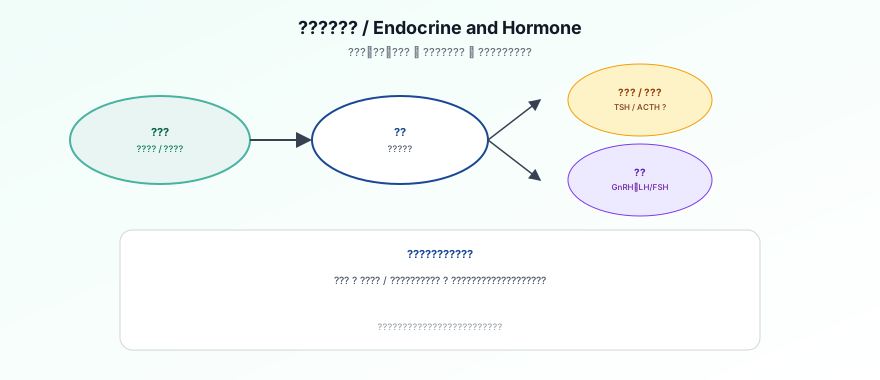
- Hypothalamic–pituitary–target gland cascades
- Steroid hormones → nuclear receptor transcription
- Peptide hormones → membrane receptors → kinases/second messengers
- Crosstalk with metabolism, immunity, and TME
8. Pathway biology overview
Endocrine signaling is shaped by timing (circadian/pulsatile dosing), dose, and organ specificity—the same hormone can yield opposite phenotypes across development or disease stage. Experiments should capture receptor isoforms, cofactors, coculture composition, and systemic metabolic readouts.
- Stress–immunity: glucocorticoids and lymphocyte apoptosis / inflammatory suppression
- Growth–cancer: IGF axis with PI3K/Akt pro-survival programs
9. Related pathways on this site
10. External databases & modification resources
11. References
Nuclear receptor mechanisms
- • Mangelsdorf DJ, et al. (1995). Cell. 83(6):841-50.
- • Heldring N, et al. (2007). Physiol Rev. 87(3):905-31.
Metabolic hormones & disease
- • Saltiel AR, Kahn CR. (2001). Nature. 414(6865):799-806.
- • LeRoith D. (2007). Nat Rev Cancer. 7(12):915-28.