PI3K/Akt/mTOR signaling pathway
Class I PI3Ks generate PIP3 from PIP2, recruiting PH-domain proteins including PDK1 and Akt. Dual phosphorylation (Thr308/Ser473) enables Akt to phosphorylate TSC2 and other nodes, relieving Rheb inhibition on mTORC1 to drive p70S6K/4E-BP1–controlled translation and growth. mTORC2 contributes to Akt Ser473 and cytoskeletal/metabolic programs. The axis crosstalks extensively with RTK–Ras–MAPK, AMPK, autophagy, and immune metabolism—central in cancer, metabolic disease, and therapy design.
1. Key targets
Human gene symbols (HGNC) along the PI3K–PIP3–PDK1/Akt–TSC–Rheb–mTORC1/2–translation/autophagy axis. Includes class I–III PI3Ks, PIP₃ phosphatases, Akt/mTOR complexes, nutrient sensing (Rag/Ragulator, GATOR), translation machinery, ULK–AMPK crosstalk, and upstream insulin/IGF, representative RTKs, and Ras–MAPK bypass nodes. Mind splice isoforms and tissue expression—annotate with databases/papers.
1.1 PI3Ks & lipid kinases
Class I makes PIP₃; class II/III remodel membrane lipids and crosstalk with RTKs, endosomes, and autophagy.
Class IA catalytic hubs:PIK3CA·PIK3CB
1.2 PIP₃ / inositol phosphatases & Akt-directed phosphatases
PTEN/INPP family lipids phosphatases; PHLPP/PP2A modules dephosphorylate Akt/mTOR sites.
1.3 PDK1, Akt & canonical outputs
Includes selected AGC kinases that parallel or feedback onto mTOR/S6K programs.
1.4 TSC–Rheb & amino-acid–mTORC1 recruitment
1.5 mTORC1/2 & rapamycin-binding proteins
1.6 mTORC1 translation outputs (S6K, 4E-BP, eIF4F, MNK/RSK)
1.7 Autophagy initiation, AMPK & DDR kinases (crosstalk)
1.8 Upstream: insulin/IGF, RTKs, Ras–MAPK
Major receptor tyrosine kinases (selected)
Large RTK gene set; representative PI3K-coupled RTKs—see HGNC / Reactome RTK modules for full lists.
EGFR, ERBB2, ERBB3, ERBB4, PDGFRA, PDGFRB, KIT, FLT1, FLT3, FLT4, KDR, MET, ALK, ROS1, RET, FGFR1, FGFR2, FGFR3, FGFR4, NTRK1, NTRK2, NTRK3, DDR1, DDR2, EPHA1, EPHA2, EPHA3, EPHA4, EPHA5, EPHA6, EPHA7, EPHA8, EPHA10, EPHB1, EPHB2, EPHB3, EPHB4, EPHB6
Core concepts (quick recap)
- PIP₃ recruits PH-domain proteins (PDK1, Akt) to membranes for dual phosphorylation and branch signaling.
- TSC complex is a Rheb GAP; Akt-driven TSC2 phosphorylation relieves Rheb inhibition on mTORC1.
- mTORC2 supports Akt Ser473 and some PKCs; ULK/AMPK antagonize mTORC1 under nutrient/energy stress.
2. Suggested experimental readouts
Pair phospho readouts with totals and stimulation/inhibitor controls; PI3K isoform vs pan-AKT probes differ—annotate PIK3CA/PIK3CB/PTEN context.
- p-AKT Ser473 / Thr308; total AKT1/2/3
- p-S6K1 Thr389, p-RPS6 Ser235/236, p-4E-BP1 Thr37/46 (clone-dependent)
- p-PRAS40, mTOR Ser2448 (mind feedback phosphorylation)
- PTEN localization/loss (IHC / sequencing)
- Pair with p-ERK1/2 to assess Ras–MAPK bypass
3. mTOR complexes at a glance
| Complex | Scaffold | Key outputs | Notes |
|---|---|---|---|
| mTORC1 | Raptor / mLST8 / DEPTOR… | S6K1, 4E-BP1, ULK1 抑制(自噬起始) | Rapamycin-sensitive (4E-BP1 may need chronic blockade). |
| mTORC2 | Rictor / mSin1 / mLST8… | Akt Ser473、部分 PKC 亚型 | First-gen rapalogs incompletely mirror mTORC2 loss. |
4. Cancer, metabolism & immunity
- Cancer: PIK3CA hotspot/amplified lesions; context-dependent PIK3CB (p110β) addiction; PTEN loss and AKT hyperactivation are frequent—watch RTK feedback and stress bypasses.
- Metabolism: Insulin–IRS–PI3K (PIK3CA/PIK3CB) controls GLUT4 and lipogenesis; AMPK antagonism/cooperation sets anabolic flux.
- Immunity: PI3Kδ/γ bias in leukocyte signaling; intersects checkpoint biology in the TME.
PI3K/Akt/mTOR–related antibodies (curated)
5. Product lines & on-site search
Primary & phospho antibodies
PI3K p110α/δ, PTEN, p-AKT (Ser473/Thr308), p-mTOR, p-S6K1, 4E-BP1, Rictor, Raptor, TSC2—WB/IHC/IF/FC as applicable.
Small molecules & probes
PI3K, Akt, and ATP-competitive mTOR inhibitors (availability-dependent)—research use per datasheets/ethics.
6. Inhibitors & tool compounds (summary)
For research use; IC50 values are indicative—validate in your system.
Pan-PI3K tool inhibitor (historical benchmark).
Class I PI3K inhibitors (clinical/preclinical contexts).
Allosteric pan-Akt inhibitor.
ATP-competitive Akt inhibitor (isoform profile per datasheet).
FKBP12–mTORC1 canonical rapalog.
Oral rapalogs; common mTORC1 positive controls.
Dual PI3K/mTOR blockade—mind off-targets.
ATP-competitive mTOR inhibitor; broader mTORC1 outputs vs rapamycin.
7. Pathway schematic
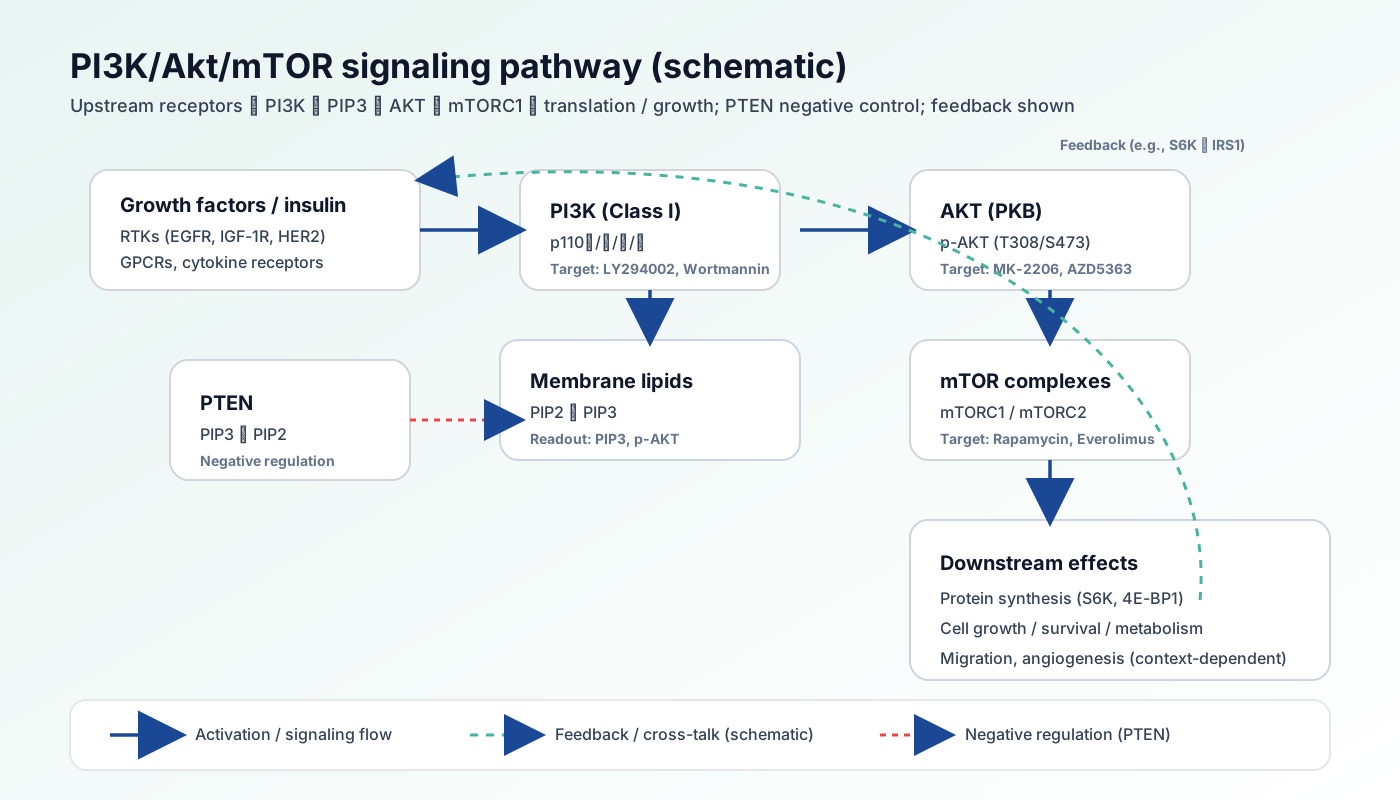
- RTK/GPCR inputs activate class I PI3K
- PIP3 recruits PDK1 and Akt
- Akt restrains TSC—Rheb licenses mTORC1
- mTORC1 drives S6K/4E-BP1; feedback reshapes receptor signaling
8. Pathway biology overview
PI3K/Akt/mTOR couples growth factors, nutrients, and anabolism: homeostatic roles in tissue maintenance and insulin sensitivity become oncogenic when amplified or PTEN-brakes are lost—driving translation, lipid, and glycolytic programs. Combination strategies must anticipate feedback (RTK, MAPK, ER stress) and immune/metabolic toxicities.
- AMPK and mTORC1 antagonize under energy stress
- Autophagy initiation is gated by mTORC1–ULK1 phosphorylation states
9. Related pathways on this site
10. External databases & resources
- KEGG: hsa04151 PI3K-Akt signaling pathway
- Reactome (search: PI3K AKT)
- WikiPathways (search: PI3K Akt mTOR)
- PhosphoSitePlus (Akt/S6K/mTOR modification sites)
11. References
PI3K family & lipid signaling
- • Vanhaesebroeck B, et al. (2010). Science. 328(5977):1664-7.
- • Engelman JA, et al. (2006). Nature. 441(7092):424-30.
Akt/mTOR in disease
- • Fruman DA, et al. (2017). Nat Rev Cancer. 17(3):149-162.
- • Manning BD, Toker A. (2017). Cell. 169(3):381-405.
Targeting & medicinal chemistry
- • Liu Y, et al. (2020). Cancer Lett. 480:148-156.
- • Laplante M, Sabatini DM. (2012). Cell. 149(2):274-93.